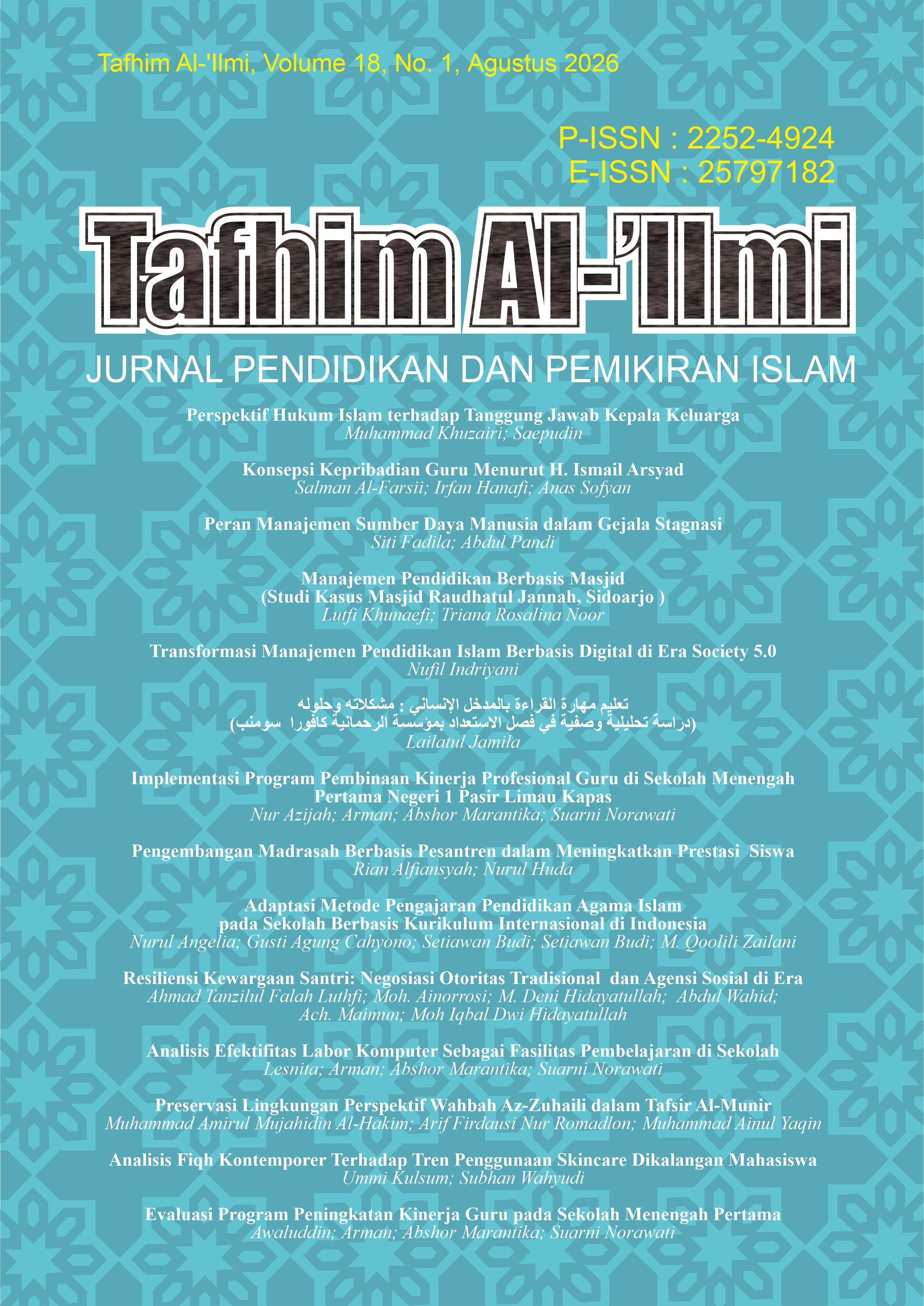
ADAPTASI METODE PENGAJARAN PENDIDIKAN AGAMA ISLAM PADA SEKOLAH BERBASIS KURIKULUM INTERNASIONAL DI INDONESIA
DOI:
https://doi.org/10.37459/tafhim.v18i01.616Keywords:
Kurikulum internasional, inquiry-based learning, learning management systemAbstract
This study aims to analyze the adaptation model of Islamic Religious Education (IRE) teaching methods in the implementation of international curricula at international curriculum-based schools in Indonesia. This research employs a qualitative approach with a case study design, involving IRE teachers and students as the research subjects. Data were collected through in-depth interviews, classroom observations, documentation studies, and open-ended student questionnaires used as a supplementary qualitative data source. Data were analyzed interactively through the stages of data reduction, data display, and conclusion drawing/verification as proposed by Miles, Huberman, and Saldaña, accompanied by source and method triangulation to maintain the credibility of the findings. The results show that teachers adapted their teaching methods by integrating inquiry-based learning, problem-based learning, collaborative learning, and the use of a Learning Management System (LMS) while maintaining Islamic values through reflective and contextual approaches. This adaptation increased student engagement and critical thinking skills, although obstacles remained in the form of limited professional training and resistance to change among some teachers. The study recommends strengthening teachers' pedagogical competence, improving digital literacy, and providing institutional policy support to integrate the global curriculum with Islamic identity.
Downloads
Published
How to Cite
Issue
Section
License
Copyright (c) 2026 Tafhim Al-'Ilmi

This work is licensed under a Creative Commons Attribution-ShareAlike 4.0 International License.
Artikel yang dimuat dalam jurnal ini boleh disebarluaskan, diterbitkan kembali, dengan syarat mencantumkan bahwa artikel tesebut telah dimuat di jurnal Tafhim al-'Ilmi dengan mencantumkan volume, nomor, dan halaman artikel terkait.